|
Science and technology aid to Tibet makes cows not afraid of "Highland Reaction"Time:2021-10-12
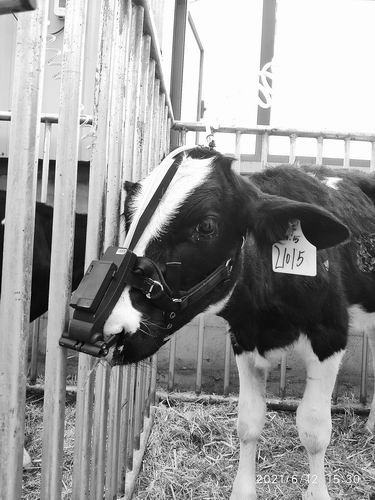
Practical application of nasal breathing mask for dairy cows. Photo by interviewee "By putting this mask on the cow, we can monitor the cow's blood oxygen saturation in real time, determine whether plateau reactions occur, and adjust the oxygen intake according to individual needs." Recently, at the 24th China Beijing International Science and Technology Industry Fair, an animal smart wearable device drew widespread attention.
This is an important achievement of the Institute of Subtropical Agricultural Ecology of the Chinese Academy of Sciences (hereinafter referred to as the Institute of Subtropical Ecology of the Chinese Academy of Sciences), together with research institutes and enterprises in the Tibet Autonomous Region, to overcome High Altitude Disease in Tibetan cows jointly developed.
For more than ten years, the Institute of Subtropical Ecology of Chinese Academy of Sciences has been providing scientific and technological assistance to Tibet, solving the worldwide problem of anti High Altitude Disease in dairy cows, and developing intelligent monitoring equipment, turning scientific and technological achievements into realistic productivity, bringing hope for prosperity to farmers and herdsmen in the plateau, and writing a colorful piece for rural revitalization in Tibet.
Breakthrough in key technology to reduce mortality
"Barley, yak and ghee are the necessities of life in Tibet. Among them, ghee is extracted from milk cream, so the local demand for milk is huge." Zhou Chuanshe, a researcher at the Institute of Subtropical Ecology of the Chinese Academy of Sciences, said in an interview with China Science News.
However, the native cows are small in body condition, and each cow produces two pounds of milk per day on average, so such a low milk yield simply cannot meet the actual demand in the Tibetan region.
"In this context, Tibet has started to introduce high-yielding good breed cows from outside the region on a large scale since the '12th Five-Year Plan', with the main breeds being Holstein cows and Juanshan cows. However, a series of factors such as high altitude and low oxygen led to the introduction of cows with Highland reactions, which seriously affected the production efficiency of cows." Basang Wangdue, director of the Institute of Animal Husbandry and Veterinary Medicine of the Tibet Autonomous Region Academy of Agricultural and Animal Husbandry Sciences (hereinafter referred to as the Institute of Animal Husbandry of the District Academy of Agricultural Sciences), told China Science News.
A year and a half after their introduction, Holstein cows had a mortality rate of 17.4% and a calf mortality rate of 35%; Juanshan cows had a mortality rate of 11% and a calf mortality rate of more than 85%.
At the same time, "affected by the geographical environment and climatic conditions, coupled with feeding management level restrictions, the introduction of good cows generally have low production performance, Holstein cows average daily milk production of about 8 kg, Juanshan cows average daily milk production of about 5 kg, less than half of the level of mainland dairy cows single yield." Basang Wangdue said.
The same cattle, why the yak and yellow cattle in the Tibetan region is not plateau reaction?
"'One side of the land raises one side of the people,' so we think there may be special functional ingredients in the forage they feed on that occur efficaciously. After combining the analysis with local functional plants, we extracted an active ingredient called 'rhodioloside' from the rhodiola plant." Zhou Chuanshe said.
Only rely on "Rhodiola Rosea" extract can not, the research team will be functional amino acids, microbial additives and plant extracts as raw materials, according to a certain ratio of compound, to develop anti-High Altitude Disease feed additives.
Zhou Chuanshe introduced, this product is mainly through improving the body's immunity, red blood cell oxygen transport capacity and the body's hematopoietic function, inhibit the body's inflammatory response, maintain the balance of the gastrointestinal microbiota of cows to achieve the purpose of prevention and treatment of high altitude disease in cows.
According to the climatic characteristics of the Tibetan region, the research team developed a targeted technical program, i.e., from May to September each year, each cow is fed 20 grams of anti-High Altitude Disease feed additive per day, and from October to April, each cow is fed 40 grams of anti-High Altitude Disease feed additive per day, and the application effect is remarkable.
The results showed that the mortality rate of Holstein cows on the farm was reduced to about 10% and the average daily milk yield was 15.90 kg, which was significantly higher than the average level of 8 kg in Tibet; the mortality rate of Jersey cows was reduced to 4% and the average daily milk yield was 13.61 kg.
"Dairy cow High Altitude Disease has been a worldwide problem that has seriously restricted the development of the local dairy industry. The technology we developed broke through the key barrier of High Altitude Disease and achieved good results, which helped promote the high-quality development of the dairy industry in the Tibetan region." Tan Zhiliang, director of the Institute of Subtropical Ecology, Chinese Academy of Sciences, said in an interview with China Science News.
Real-time monitoring, intelligent farming
High Altitude Disease are difficult to detect, prevent, monitor and treat, but preventing them is always more important than treating them.
The research team realized that developing an intelligent monitoring device that can monitor the physiological condition of cows in real time is important for the prevention and treatment of High Altitude Disease.
"It's a carrier device, but how to fix it on the cow is not an easy task." Zhou Chuanshe said that from the very beginning, when it was fixed on the cow's ear and then on the neck, the effect was lacking. "Now, we have developed to the fourth generation of the product, a wearable device that is fixed on the head like a breathing mask."
This wearable all-in-one device can monitor the physiological status of cows in real time, and the device combines real-time monitoring of cow blood oxygen saturation, heart rate, blood perfusion and oxygen therapy in one.
"High Altitude Disease is better when detected and treated early. The level of blood oxygen saturation can reflect the degree of hypoxia of the organism, and when the blood oxygen saturation drops to a certain threshold, this intelligent device will issue a timely warning and provide nasal oxygen inhalation for cows according to the actual demand to achieve early intervention treatment, thus reducing morbidity and mortality." Li Bin, an associate researcher at the Institute of Animal Husbandry of the Regional Academy of Agricultural Sciences, told China Science News.
In addition, the research team has expanded the monitoring of cow movement, body temperature and estrus, and is able to transmit the physiological condition of cows to mobile terminals in real time through 4G data transmission, realizing real-time monitoring of the health condition of highland cows over long distances to achieve the purpose of early detection, early prevention and early treatment, completely solving the "four difficulties" of High Altitude Disease The problem.
Zhou Chuanshe introduced that this equipment has been verified on a large scale on nearly 5,000 cows in four farms in Tibet, and is highly recognized and is being promoted on a large scale in Tibet.
It is worth mentioning that after the research team has a detailed understanding of the physical condition and vital signs of each cow based on the real-time monitoring values, the cows in the pasture will be divided into herds and scientifically monitored and managed through different feed addition gradients as well as addition times.
"Compared with the common situation of mixed feeding, such a practice can greatly reduce the farm's breeding costs, on-demand scientific distribution, will also improve the milk production efficiency of the herd." Zhou Chuanshe said.
The Strategic Plan for Rural Revitalization (2018-2022) issued by the Central Committee of the Communist Party of China and the State Council states that the grass-fed animal husbandry industry should be vigorously developed and the national dairy industry should be expanded and strengthened. In Li Bin's view, these achievements developed by the team are an important part of the development of intelligent animal husbandry and have a broad prospect.
Promote farmers and herdsmen to increase their income
"Tibet has no high-precision industries, and grass-fed animal husbandry is still an important breakthrough for rural revitalization and industrial prosperity in Tibetan areas." Tan Zhiliang pointed out.
But from the external background of the development of grass and pasture industry in Tibetan region, under the pressure of "double red line" of national ecological security barrier construction (ecological red line) and Tibet's own food security (food red line), the land resources that can support forage production, especially arable land resources, are very limited in the whole region.
On the other hand, the serious shortage of forage and the imbalance between grass and livestock are still the primary problems facing the region at present and even in the long term. "Most of the native is low-quality roughage with low breeding efficiency, while the logistics cost of purchasing feed from outside accounts for more than half of the overall feed cost." Zhou Chuanshe said.
In the view of the research team, this dilemma of external "double high pressure" and internal contradictions is the main reason for the slow development of the grass-feeding industry in Tibet.
"Promoting the development of the local grass-farming industry and increasing the income of farmers and herdsmen is a very important part of our work." Tan Zhiliang said.
So, how to effectively expand the space and ways for Tibetan farmers and herdsmen to increase their income? "The most urgent task is to improve the comprehensive farming efficiency." Zhou Chuanshe answered.
Since 2011, the Institute of Subtropical Ecology of the Chinese Academy of Sciences has been conducting research on the development and utilization of forage resources, and has assessed the nutritional value of ryegrass, reed fescue, reed, oat grass, alfalfa, and crop straw including corn straw, barley straw, rape straw, pea straw, and wheat straw as commonly used forage feed resources in Tibet, and finally determined that reed fescue and corn straw are suitable for animal husbandry in Tibet. The two types of roughage suitable for livestock breeding in Tibetan areas were finally identified.
On the basis of the original feeds in Tibet, the research team also further optimized and adjusted the formula for dairy cows in Tibet to get a feed formula suitable for healthy breeding of dairy cows in Tibet.
"Combining the application of anti plateau disease feed additives and feed formulations has achieved good economic and social benefits." Li Bin said.
The team used the research results to promote a total of more than 3,000 cows in the Tibetan Quanfeng high-standard dairy farming base, making the farm lactating cows from an average yield of 3.5 tons per unit to an average yield of 5 tons per unit, reaching the leading level of dairy cows per unit in Tibetan areas; adding more than 3 million yuan of new profits for the farming base each year, which plays an important role in promoting farmers and herdsmen to increase their income.
"In the next step, we will continue to overcome some difficulties in the adaptation of dairy cows to the plateau through cooperation. In addition, we will also promote and demonstrate the core key technologies that are suitable for ecological grass grazing in a way that is acceptable to farmers and herdsmen in Tibetan areas. And to further condense and improve the basic research on the mechanism of livestock breed adaptability, and support the sustainable development of Tibetan grass grazing industry with science and technology." Tan Zhiliang said.
Zhang Qingdan
Source: China Science News |